
 °C
°C
 4
Min
4
Min
BANGKOK (AP) – Rescuers tried to reach seven villagers trapped inside a flooded cave in Laos for the seventh day on Tuesday, with difficult terrain and weather impeding their efforts. There has been no contact with them since they became trapped.
Search continues for 7 villagers trapped in a flooded cave in Laos
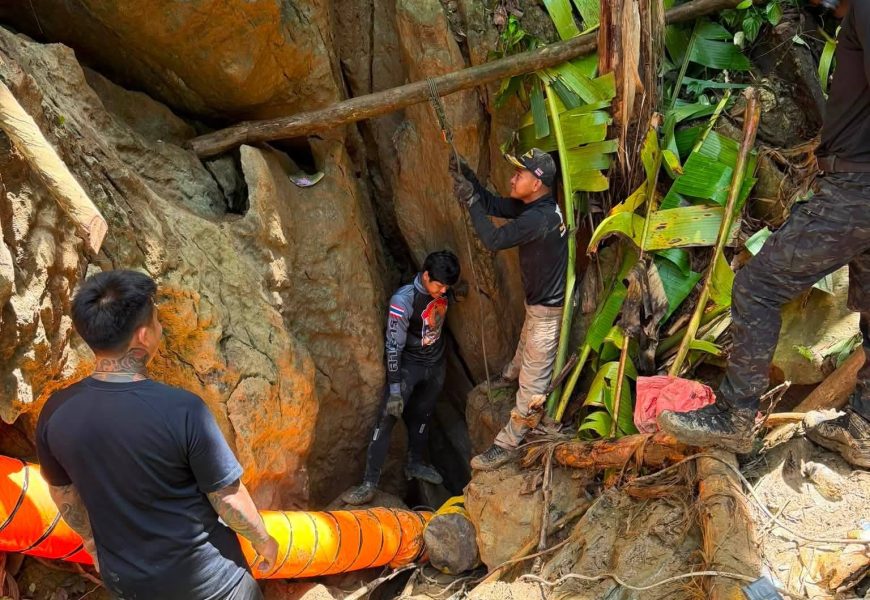

BANGKOK (AP) - Rescuers tried to reach seven villagers trapped inside a flooded cave in Laos for the seventh day on Tuesday, with difficult terrain and weather impeding their efforts. There has been no contact with them since they became trapped.
The villagers entered the cave in Xaisomboun province on May 19, but heavy rain triggered flash flooding that blocked their exit, according to Lao and Thai rescue teams involved in the operation.
The Lao organization Rescue Volunteer for People, which is working closely with the local authorities, posted on its Facebook page that Tuesday's operation plan included exploring air shafts above the cave in hopes of identifying possible access points and locating the trapped people.
Rescue workers from neighboring Thailand arrived at the site over the weekend to assist the operation. Those helping out include divers from several nations who took part in the complicated 2018 rescue in northern Thailand of 12 schoolboys and their soccer coach who were trapped for more than two weeks in a cave before being safely extricated.
According to rescuers, divers have navigated about 100 meters (330 feet) into the flooded, narrow cave. They believe the villagers may be trapped about 30 meters (100 feet) beyond the furthest point currently accessible and are also working to pump water out of the cave to aid the rescue operation.
The site is in a rugged, remote area in Xaisomboun province's Longcheng district, which is about 120 kilometers (75 miles) north of the capital, Vientiane. Rescuers at the scene have detailed on social media the challenging mountainous terrain and heavy rain that is hampering their work.
Videos shared online by Thai rescuers showed that reaching the cave's entrance requires a steep hike on foot of roughly 4 kilometers (2.5 miles). The entrance is also steep and rocky, and barely wide enough for a single person at a time to climb through.
Inside, rescuers must make their way through muddy passageways, flooded sections and narrow tunnels that forced them to crawl.
Claus Rasmussen, a diving instructor based on the Thai island of Phuket who took part in the 2018 rescue in Thailand's Chiang Rai province, told The Associated Press he has been following the situation in Laos, although he is not currently involved.
"The villagers up there are used to living on very little, but that also means that they may not have a lot of sustenance in their body to actually deal with whatever is going on," he said in a video interview.
He noted that other circumstances also weigh against them: the possibility of collapsed tunnels, physical injuries "and everything else, which obviously increase that risk of them not coming through it in a safe manner."
There has been no official confirmation on why the villagers went into the cave.
However, Bounkham Luanglath of the Lao rescue group said that the cave was frequented by local residents looking for gold, even though authorities had repeatedly warned them against entering the cave out of safety concerns.
The average per capita income in Laos of about $2,000-2,500 is among the lowest in Southeast Asia, and it is much less in rural areas.
Laos is not known as a major gold producer, but its mining industry is sizable considering the country's developing economy. The mining sector is fueled by foreign direct investment, largely from neighboring Thailand and China. Copper is a major export, and mining for rare earth elements, needed for most modern technologies, has become more common in Laos recently.
The Laos Foreign Ministry on Tuesday said it has no official information to share with the media. The Southeast Asian nation is a one-party communist state with no organized opposition and the government keeps a tight lid on information.
The cave crisis quickly drew headlines in Thailand because of its resemblance to the dramatic 2018 cave rescue in northern Thailand, which became a global sensation. A former Thai navy SEAL diver died during that search and rescue effort.
A major health risk for those trapped in a cave is cold conditions quickly leading to hypothermia. The body can cope for weeks without food, but clean water is necessary to prevent dehydration. A contaminated water supply could cause diarrhea, hastening dehydration.
Declining oxygen levels cause symptoms similar to altitude sickness and in the long run can damage the lungs and other organs, while carbon dioxide buildup causes exhaustion and eventual unconsciousness.
Constant darkness disrupts time perception and the body's circadian rhythms. It also causes extreme sensitivity when the eyes have to adjust again to light.
Recalling the 2018 rescue operation in Thailand, when fears were high for the boys' fate, diver Rasmussen said it showed survival is possible even when it appears unlikely.
"Here it is still a rescue until proven otherwise," he said. "And that's the way that people have to go forward."
More Top Stories