
 °C
°C
 4
Min
4
Min
The NCAA Tournament is getting a supersized makeover, a long-expected expansion that many basketball fans should notice and pay attention to beginning next season.
What about Cinderella and the brackets? What to know about NCAA Tournament expansion
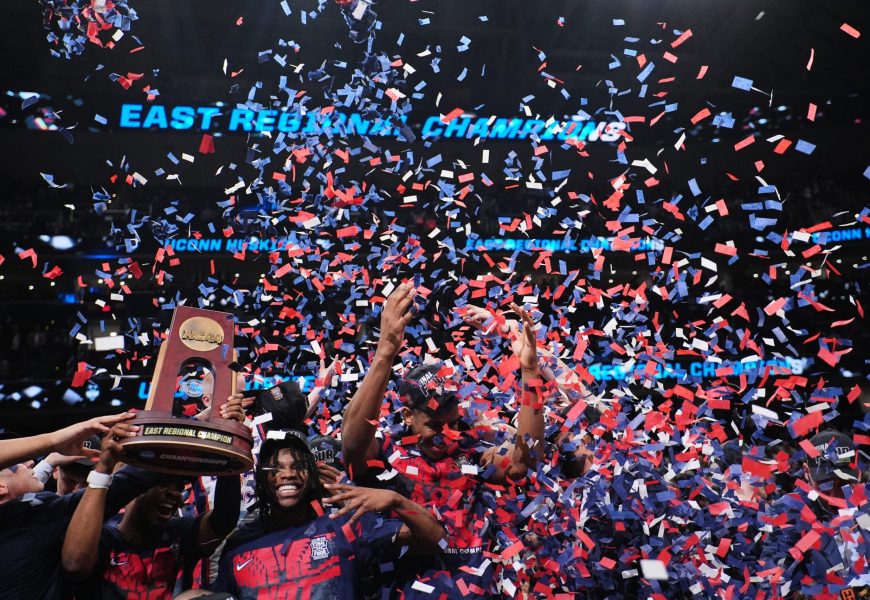

The NCAA Tournament is getting a supersized makeover, a long-expected expansion that many basketball fans should notice and pay attention to beginning next season.
The sanctioning body increased the fields for its men's and women's March Madness tournaments to 76 teams apiece on Thursday. That means there will be eight more games - 12 total involving 24 teams - squeezed into the highly popular bracket without substantially changing the overall format.
NCAA coaches and administers have lobbied for more access to the lucrative, postseason showcase for years. The biggest questions always revolved around how many teams would get in and what would the new setup look like.
The first expansion of the tournaments in years - the men from 65 to 68 in 2011, followed by the women from 64 to 68 in 2022 - will turn what has been known as the First Four into a bigger affair that will now be called the March Madness Opening Round.
The 12 winners will move into the main 64-team bracket that will begin, as usual, on Thursday for the men and Friday for the women.
Money seems like the primary reason, though some will argue it's about providing more spots for deserving teams.
The change comes at a time when conferences and universities are desperately looking for ways to add revenue. Some schools are strapped for cash while having to share revenue with top athletes and are trying to better position themselves for the next iteration of the ever-changing landscape of college sports. With schools now allowed to spend more than $20 million on their athletes, the race to stay competitive is frenetic.
The NCAA said it will distribute more than $131 million in new revenue to schools that make the tournament. That money will come from expanded TV advertising opportunities for alcohol, the likes of which were previously restricted. It said the value of the rights agreement will increase $50 million each year on average over the course of the six years remaining on existing broadcast agreements with CBS and others.
Most of the eight new slots are expected to go to teams from the four power conferences - Atlantic Coast, Big Ten, Big 12 and Southeastern - that were already commanding the bulk of the entries in the bracket.
Keith Gill, the chairman of the Division I men's basketball committee, called the expansion "a nice way to create some access but make sure we have the bracket we all love when we start Thursday at noon."
Although no mid-major program advanced past the first weekend of either tournament the last two seasons, there still will be a chance for someone to make a run to the Sweet 16 or maybe even the Final Four.
Leaders in the power conferences acknowledge that smaller programs - most recently Saint Peter's in 2022, Loyola Chicago in 2018 and George Mason in 2006 - help make March Madness what it is.
Those sorts of teams will have a path, even if revenue sharing and name, image and likeness payments have it increasingly more difficult for mid-major programs to keep talent beyond one year. And remember, there was actually concern last season that a Miami (Ohio) team with a 31-1 record would be left out.
On the men's side, Auburn, Cincinnati, Indiana, Oklahoma and San Diego State surely would have slipped into the field and landed a spot in the opening round. Those schools surely would have drawn more attention - and more TV ratings - than many of the teams in the First Four: Howard, Lehigh, Miami (Ohio), Prairie View, SMU and UMBC.
On the women's side, BYU, Cal, Texas A&M and Utah likely would have made the field and gotten more eyeballs than games including Missouri State, Samford, Southern and Stephen F. Austin.
Most brackets excluded the First Four and began with first-round games played Thursday (men) and Friday (women).
Having eight more teams playing in the opening round could change that - and make it more difficult for someone - or artificial intelligence - to land that elusive perfect bracket.
The late DePaul mathematics professor Jeffrey Bergen calculated the odds of picking a perfect bracket at 1 in 9.2 quintillion, assuming every game is a 50-50 proposition, or about 46 million times the number of stars in our galaxy. Adding eight games to the mix won't make it any easier.
More Top Stories