
 °C
°C
 6
Min
6
Min
PITTSBURGH (AP) – In the space of a couple of weeks this spring, Pittsburgh media has lived through a near-death experience and a resurrection.
Facing the death of its dominant newspaper, Pittsburgh media has surprising turnaround
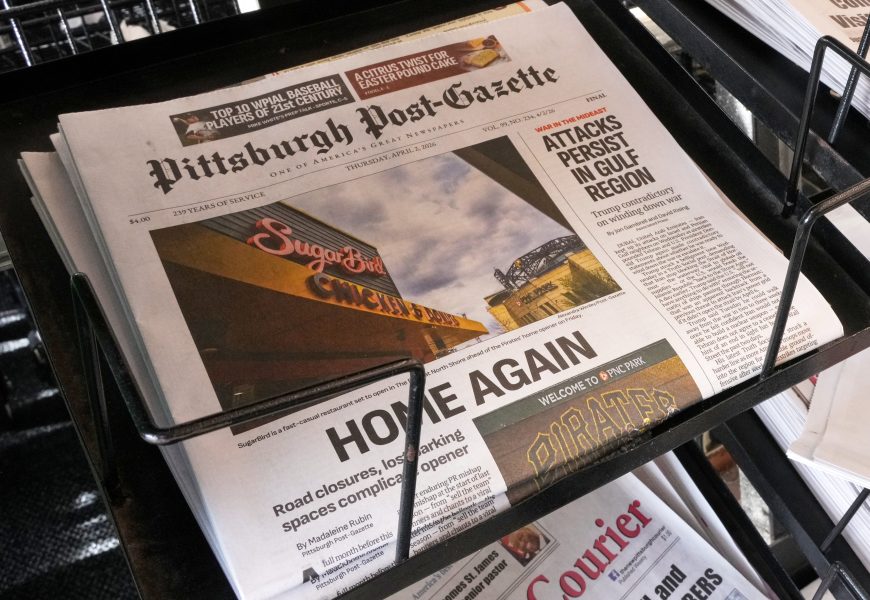

PITTSBURGH (AP) - In the space of a couple of weeks this spring, Pittsburgh media has lived through a near-death experience and a resurrection.
Owners of the Pittsburgh Post-Gazette last week announced the newspaper's sale to a nonprofit foundation that said it was committed to keeping it open. A news outlet that predates the U.S. Constitution was due to close on May 3, which would have made the Steel City the nation's largest community without a city-based paper.
Weeks earlier, the alternative Pittsburgh City Paper, whose staff learned on New Year's Day that it was closing after 34 years, roared back to life under new ownership.
They were rare positive developments for a local news industry that has seen its share of the opposite over the past two decades - newsrooms shuttered or thinned out, journalists thrown out of work, consumers drifting away. No one is pretending that a true turnaround will be easy in Pittsburgh. One thing that may help is that the city faced a news abyss and was forced to prepare for it.
"It's human nature that sometimes you have to be shaken a bit to realize what's important in your life," said Halle Stockton, co-executive director and editor-in-chief of the digital news outlet Public Source.
The Pittsburgh Gazette was born on July 29, 1786, the first newspaper west of the Allegheny Mountains. It went through several names with the expansion and contraction of a newspaper market that supported seven at the beginning of the 20th century. There was The Commercial Gazette, the Gazette-Times and, briefly, the Pittsburgh Gazette and Manufacturing and Mercantile Advertiser.
A consolidation caused by the closing of the Pittsburgh Post in 1927 made it the Post-Gazette, which has remained its name for 99 years.
It had a solid reputation, winning a Pulitzer Prize in 2019 for its coverage of the Tree of Life synagogue shooting. "The Post-Gazette is really the paper of record for this city," said Kevin Acklin, chief of staff to a former Pittsburgh mayor and former president of the Penguins hockey team. The other longtime "paper of record," The Pittsburgh Press, closed in 1992 after a Teamsters Union strike.
Labor woes marred the Post-Gazette's last few years as well. Much of the staff was on strike between 2022 and 2025, though the newspaper limped along. Its owner, Block Communications, Inc., announced the closing in January.
To anyone watching closely, a clue to the newspaper's future was revealed across town in mid-March.
"You thought we were dead and gone, didn't you?" Ali Trachta, top editor at the Pittsburgh City Paper, wrote on the outlet's revived website. She announced the paper was returning, bought by a new nonprofit of local investors. That former owner? Block Communications.
When Block announced its sale of the Post-Gazette last week, it was also to a nonprofit - the Venetoulis Institute for Local Journalism, which publishes the digital success story The Baltimore Banner. Many in Pittsburgh feared it would be sold to a hedge fund notorious for stripping newspapers of resources.
Does that make Block, long seen as a villain in the local journalism industry, a hero in this story?
"For better or worse, the Blocks will never get credit for that," said Andrew Conte, a journalism professor at Point Park University who runs Pittsburgh's Center for Media Innovation. "But it does seem like they made an effort to come up with the best outcome they could as they were leaving Pittsburgh. They could have just walked away and said, 'You know, we're done.'"
Now the work begins. The new owner's benefactor, hotel magnate Stewart Bainum Jr., has said that he plans to invest $30 million in both the Banner and Post-Gazette over the next five years.
"This is going to be one of the most closely-watched newspaper acquisitions in years," said Tim Franklin, founding director of the Medill Local News Initiative at Northwestern University. "Can a money-losing newspaper with serious labor strife be saved and resurrected as a non-profit? If Stewart Bainum and his team pull this off - and I hope they do - it could be a model for the nation."
Anticipating a Pittsburgh without the Post-Gazette, other news sources in the city had begun making plans to fill gaps in the marketplace, and they're not necessarily changing them because of the sale.
Another area newspaper, the Pittsburgh Tribune-Review, will reinstate a Sunday print edition in Pittsburgh on May 9 and will add about a dozen new journalists, said Jennifer Bertetto, its CEO.
Stockton's Public Source, launched in 2011 primarily as a home for investigative news stories, is widening its outlook. The outlet has also convened town halls over the past few months for residents to talk about what they want in local news, and published a list of 40 to 50 small news outlets in the region that focus on subject areas like the arts and business, or different neighborhoods and towns.
People less engaged in news were looking for new ideas. "People are actively interested in where they get their information and who they can trust for it," Stockton said. "So we're leaning into that."
With their careers in limbo the past several months, Post-Gazette content editor Erin Hebert and photographer Steve Mellon were among several journalists meeting regularly as the Pittsburgh Alliance for People-Empowered Reporting, or PAPER, seeing if they could create a digital news site. Those plans are up in the air.
Conte can walk a few blocks from the university to show office space set aside for journalists from small, local publications. He hopes to convince the Tribune-Review to print a periodic insert featuring the best reporting from these outlets. Conte, a former Trib reporter, recalled his old paper's bitter competition with the Post-Gazette.
"Literally, they were trying to kill each other," he said. "I don't think any of us want to go back to a point where we're doing that. We've evolved. We're trying to work together. Even if we're competing for scoops and clicks and dollars, there's also a benefit to having us get around the same table once a month."
More Top Stories